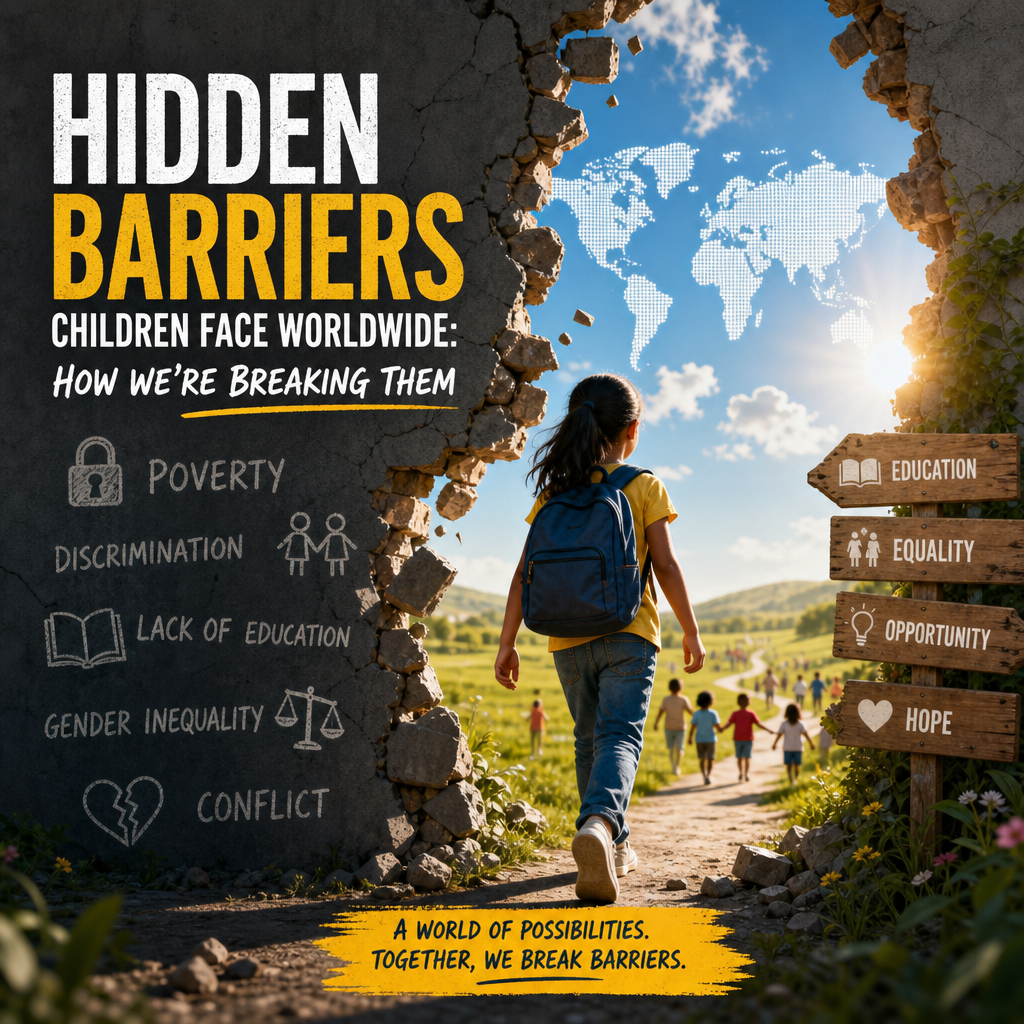
Hidden Barriers Children Face Worldwide: How We’re Breaking Them
The Hidden Barriers Children Face Worldwide — And How We Are Breaking Them
Every child deserves the chance to learn, grow, play, and feel safe. Yet for millions of children, that chance is blocked by obstacles that are not always visible at first glance. These are the hidden barriers children face worldwide: poverty, discrimination, conflict, disability, poor health, gender inequality, and lack of access to essential services.
These barriers often work quietly in the background, shaping a child’s future long before anyone notices. The good news is that they are not permanent. Around the world, communities, organizations, and advocates are finding practical ways to break them down.
What Makes These Barriers “Hidden”?
Some barriers are obvious, such as war, hunger, or destroyed schools. Others are harder to see but just as damaging.
A child may look healthy and active, but still be unable to attend school because their family cannot afford uniforms or transport. Another may be eager to learn but excluded because they speak a minority language. A child with a disability may be ready to participate, but face a school building with no ramp, no support, and no inclusive teaching tools.
These challenges often overlap. One barrier can lead to another, creating a cycle that is difficult to escape.
Common hidden barriers include:
- Poverty and food insecurity
- Gender-based discrimination
- Disability and lack of accessibility
- Unsafe travel to school
- Conflict and displacement
- Limited healthcare and mental health support
- Language and cultural exclusion
- Digital inequality
Why These Barriers Matter So Much
When children are blocked from education, healthcare, nutrition, and protection, the effects reach far beyond childhood. Missing school today can mean fewer job opportunities tomorrow. Poor nutrition can slow learning and growth. Trauma can shape emotional development for years.
In other words, the hidden barriers children face worldwide do not just affect individual children. They affect families, communities, and entire societies.
A child who is supported early is more likely to:
- Stay in school
- Build confidence
- Develop healthy relationships
- Contribute to their community
- Break the cycle of poverty
That is why breaking these barriers is one of the most important investments the world can make.
How We Are Breaking Them
The progress may not always be dramatic, but it is real. Across regions and sectors, people are working to remove the obstacles children face before they become lifelong limits.
1. Making education more inclusive
Schools are changing to welcome every learner. This includes accessible classrooms, language support, free learning materials, and teacher training that helps educators understand diverse needs.
In many places, simple changes make a big difference:
- Braille books and screen readers for visually impaired students
- School meals that improve concentration and attendance
- Safe transport for children in remote areas
- Flexible learning options for displaced children
2. Strengthening community support
Children do best when the adults around them are informed and involved. Community-based programs are helping families access nutrition, health services, parenting support, and legal aid.
When parents are given tools and knowledge, they are better able to advocate for their children and spot problems early.
3. Using technology to reach more children
Digital tools are opening doors for children who once had none. Mobile health programs, online learning platforms, and remote counseling are helping bridge gaps in places with limited infrastructure.
Of course, technology is not a complete solution. Many children still lack internet access or devices. But when used thoughtfully, it can expand opportunity in powerful ways.
4. Protecting children in crisis
In conflict zones and disaster-affected areas, urgent action is essential. Humanitarian groups are creating child-friendly spaces, delivering emergency education, restoring health services, and helping families stay together.
These efforts do more than meet immediate needs. They help children regain a sense of safety and routine, which is critical for recovery.
What Real Change Looks Like
Real change often starts small.
It may be one school that becomes accessible. One teacher who notices a struggling student. One clinic that reaches a remote village. One policy that protects children from discrimination. One community that decides every child matters.
These changes may seem small on their own, but together they shift entire systems.
The hidden barriers children face worldwide cannot be solved by one person or one project alone. They require coordination, commitment, and the belief that every child deserves a fair start.
A Future Built on Possibility
Breaking barriers is not only about removing obstacles. It is about creating conditions where children can thrive. It means designing schools, services, and communities with children in mind from the beginning, not as an afterthought.
It also means listening to children themselves. They often know exactly what is missing: safety, dignity, belonging, and a chance to be heard.
The more we act on those truths, the closer we get to a world where a child’s future is shaped not by hidden barriers, but by open doors.
And that is a future worth building.