
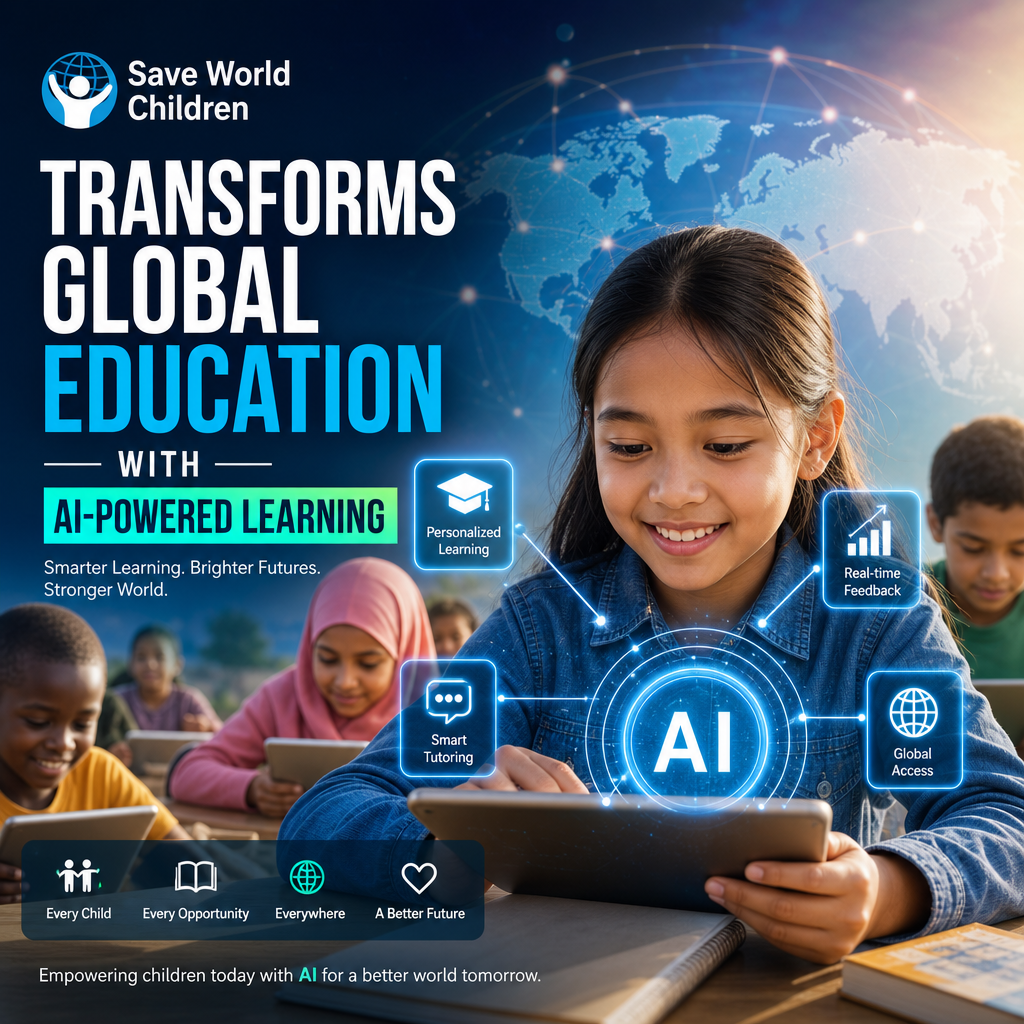
Save World Children Transforms Global Education with AI-Powered Learning
How Save World Children Is Transforming Global Education Through AI‑Powered Learning
Education is changing fast, and one of the most promising forces behind that change is artificial intelligence. Around the world, millions of children still face barriers to quality learning, from overcrowded classrooms to a shortage of trained teachers and limited access to learning materials. Save World Children is helping close that gap by using AI-powered learning to make education more personalized, accessible, and effective.
Rather than replacing teachers, this approach supports them. It gives students learning experiences that adapt to their needs while giving educators better tools to reach every child. In communities where resources are stretched thin, that kind of support can make a real difference.
Why AI-powered learning matters
Traditional education systems often follow the same pace for every learner. But children do not learn at the same speed, in the same way, or with the same background knowledge. Some need extra practice. Others need more challenge. Many need instruction in a language they understand best.
AI-powered learning helps solve these issues by analyzing how each student responds to lessons and then adjusting the experience in real time. That means:
- weaker areas receive more attention
- advanced learners can move ahead faster
- lessons can be tailored to different languages and reading levels
- teachers can see where support is needed most
For organizations like Save World Children, this technology is especially valuable in underserved regions where one teacher may be responsible for many students with very different needs.
How Save World Children is using AI in education
Save World Children is applying AI to create learning systems that are both practical and inclusive. The goal is not to build a high-tech classroom for a few, but to expand opportunity for many. By combining digital tools with human-centered design, the organization is making education more flexible for children in diverse environments.
Personalized learning paths
One of the biggest strengths of AI is personalization. Save World Children uses learning tools that track progress and adjust lessons automatically. If a child struggles with reading comprehension, for example, the platform can offer simpler texts, more repetition, or visual support. If another child excels in math, the system can present more advanced challenges.
This kind of adaptation helps children stay engaged and prevents them from falling behind.
Teacher support and efficiency
Teachers remain at the center of learning, but AI can reduce the burden of routine tasks. Save World Children’s approach helps educators save time by automating certain assessments, identifying learning gaps, and organizing data in a useful way.
That means teachers can focus more on mentoring, motivation, and direct instruction. In places where classrooms are crowded and resources are limited, this support can be a game changer.
Reaching children beyond the classroom
Many children cannot attend school consistently because of conflict, poverty, illness, disability, or distance. AI-powered learning can extend education beyond physical school walls. Save World Children is helping build learning models that can be accessed on low-cost devices and adapted for offline or low-bandwidth use.
This makes it possible for more children to continue learning even when traditional schooling is interrupted.
The global impact of smarter learning
The promise of Save World Children’s work is not only about technology. It is about equity. When learning tools become more responsive and more available, children who were once left out get a better chance to succeed.
AI-powered learning can support global education in several important ways:
- Improved literacy and numeracy through targeted practice
- Greater inclusion for children with different abilities and learning styles
- Scalable support for schools and communities with limited staff
- Better learning outcomes through continuous feedback and adaptation
- More engagement because students learn at a pace that suits them
These outcomes matter because education is one of the strongest drivers of long-term opportunity. A child who can read well, solve problems, and think critically has a better chance to thrive in school and in life.
Challenges that still need attention
While AI brings exciting possibilities, it also comes with responsibility. Save World Children’s work highlights an important truth: technology must be used carefully and ethically.
Some of the key challenges include:
- protecting children’s data and privacy
- ensuring tools are affordable and accessible
- avoiding bias in AI systems
- training teachers to use new platforms effectively
- making sure technology supports, rather than dominates, learning
These issues matter because global education should be inclusive, safe, and human-centered. The best AI solutions are the ones that serve children, not the other way around.
A more hopeful future for learning
The future of education will likely be a blend of human guidance and intelligent digital support. Save World Children is showing how that future can begin today. By using AI-powered learning to personalize instruction, support teachers, and reach children in difficult circumstances, the organization is helping reshape what global education can look like.
The result is more than a digital upgrade. It is a stronger, more flexible system that gives children a fairer chance to learn, grow, and succeed.
As AI continues to evolve, efforts like Save World Children’s will be essential in ensuring that innovation reaches the children who need it most. In that sense, the transformation of global education is not just about technology. It is about opening doors, one learner at a time.