
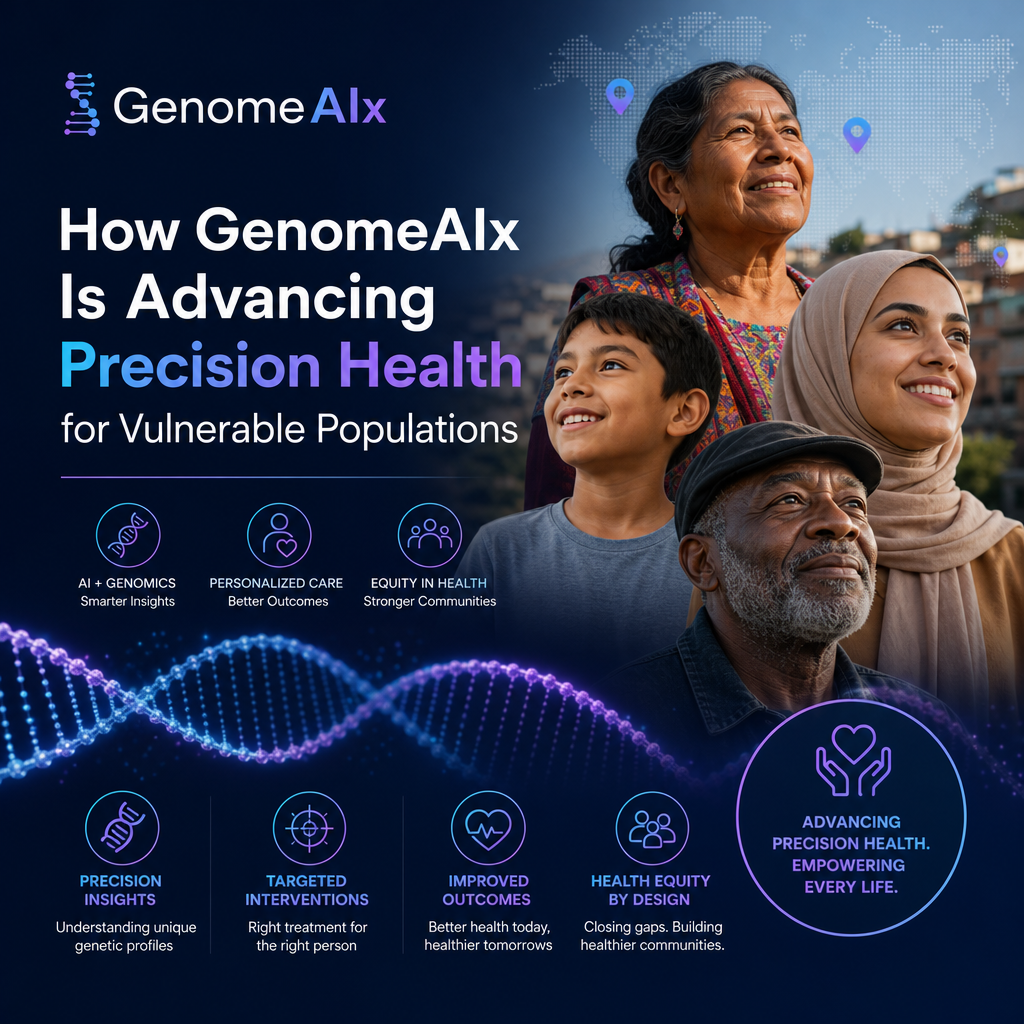
How GenomeAIx Is Advancing Precision Health for Vulnerable Populations
How GenomeAIx Is Advancing Precision Health for Vulnerable Populations
Precision health promises care that is tailored to each person’s biology, environment, and life circumstances. For many communities, though, that promise has been slow to arrive. People in rural areas, low-income neighborhoods, and historically marginalized groups often face barriers to screening, diagnosis, and treatment that make one-size-fits-all medicine especially ineffective.
That is where GenomeAIx is helping shift the landscape. By combining genomic analysis with artificial intelligence, GenomeAIx is making it easier to identify risk earlier, personalize care plans, and bring precision health tools to populations that have often been left out of medical innovation.
Why Vulnerable Populations Need Precision Health
Vulnerable populations frequently face a mix of challenges that affect health outcomes, including:
- Limited access to healthcare facilities
- Fewer opportunities for preventive screening
- Higher rates of chronic stress and environmental exposure
- Underrepresentation in medical research
- Delayed diagnosis and treatment
These barriers can lead to worse outcomes even when the same disease is involved. Precision health aims to reduce that gap by using more detailed information to guide care. Instead of treating everyone with the same approach, it looks at genetic variation, social context, and personal risk factors to support better decisions.
What GenomeAIx Brings to the Table
GenomeAIx uses AI-driven tools to interpret complex biological data faster and more accurately than traditional methods. That matters because genomic information can be difficult to analyze at scale, especially when health systems are already stretched thin.
Faster Risk Identification
One of the biggest advantages of GenomeAIx is its ability to help clinicians identify elevated risk earlier. For vulnerable populations, early detection can be life-changing. A patient with a family history of inherited disease, for example, may benefit from earlier monitoring or preventive care before symptoms appear.
Better Personalization
Precision health works best when care is matched to the individual. GenomeAIx helps clinicians go beyond broad population averages by highlighting genetic markers, disease patterns, and treatment responses that may be relevant to a specific patient. This can support more informed decisions around:
- Medication selection
- Screening schedules
- Preventive interventions
- Follow-up timing
Scalable Insights
In communities where specialist support is limited, scalable AI tools can make a major difference. GenomeAIx can help health systems process large amounts of data more efficiently, which may improve access to advanced analysis in settings that do not have extensive in-house genetics teams.
Closing the Equity Gap in Healthcare
One of the most important benefits of GenomeAIx is its potential to support health equity. Precision health has sometimes been criticized for serving mostly people who already have access to advanced care. GenomeAIx can help change that by making advanced insights more practical for broader and more diverse populations.
Supporting Underrepresented Groups
Many genomic databases have historically overrepresented certain populations while leaving others behind. This creates gaps in accuracy and relevance. By prioritizing diverse data inputs and equitable model design, GenomeAIx can help produce insights that are more useful across different ancestries and communities.
Improving Preventive Care
Preventive medicine is often where vulnerable populations experience the biggest system failures. When screenings are missed or risks are underestimated, treatable conditions can become serious. GenomeAIx supports a more proactive approach by helping providers detect possible issues sooner and tailor follow-up care more effectively.
Reducing Waste in Care Delivery
When healthcare is guided by better data, systems can avoid unnecessary testing, ineffective treatments, and delayed interventions. That is especially valuable in under-resourced settings, where every visit and every dollar matters.
Real-World Impact in Community Health
The value of GenomeAIx is not just in better data analysis. It is in what that analysis enables on the ground. Community clinics, public health programs, and safety-net providers can use precision health insights to better allocate resources and focus attention where it is most needed.
For example, GenomeAIx could help identify patients who are more likely to benefit from:
- Earlier cancer screening
- Targeted medication adjustments
- Cardiometabolic risk monitoring
- Genetic counseling referrals
These are not abstract improvements. They can mean earlier intervention, fewer complications, and better long-term outcomes.
The Human Side of AI in Health
Technology alone does not create better care. Trust, communication, and cultural understanding still matter. That is why GenomeAIx is most powerful when used as part of a broader commitment to patient-centered medicine.
Providers need to explain results clearly, respect community concerns, and ensure that patients understand what genomic data can and cannot tell them. When AI is paired with empathy and transparency, it becomes a tool for empowerment rather than exclusion.
Looking Ahead
The future of precision health depends on making innovation more inclusive. GenomeAIx is helping lead that transition by turning complex genomic information into practical guidance for clinicians and care teams. For vulnerable populations, that means a real chance at earlier intervention, more accurate treatment, and better outcomes.
As healthcare continues to evolve, the most meaningful progress will come from tools that do more than advance science. They will also need to advance fairness. GenomeAIx is showing how precision health can move in that direction.