

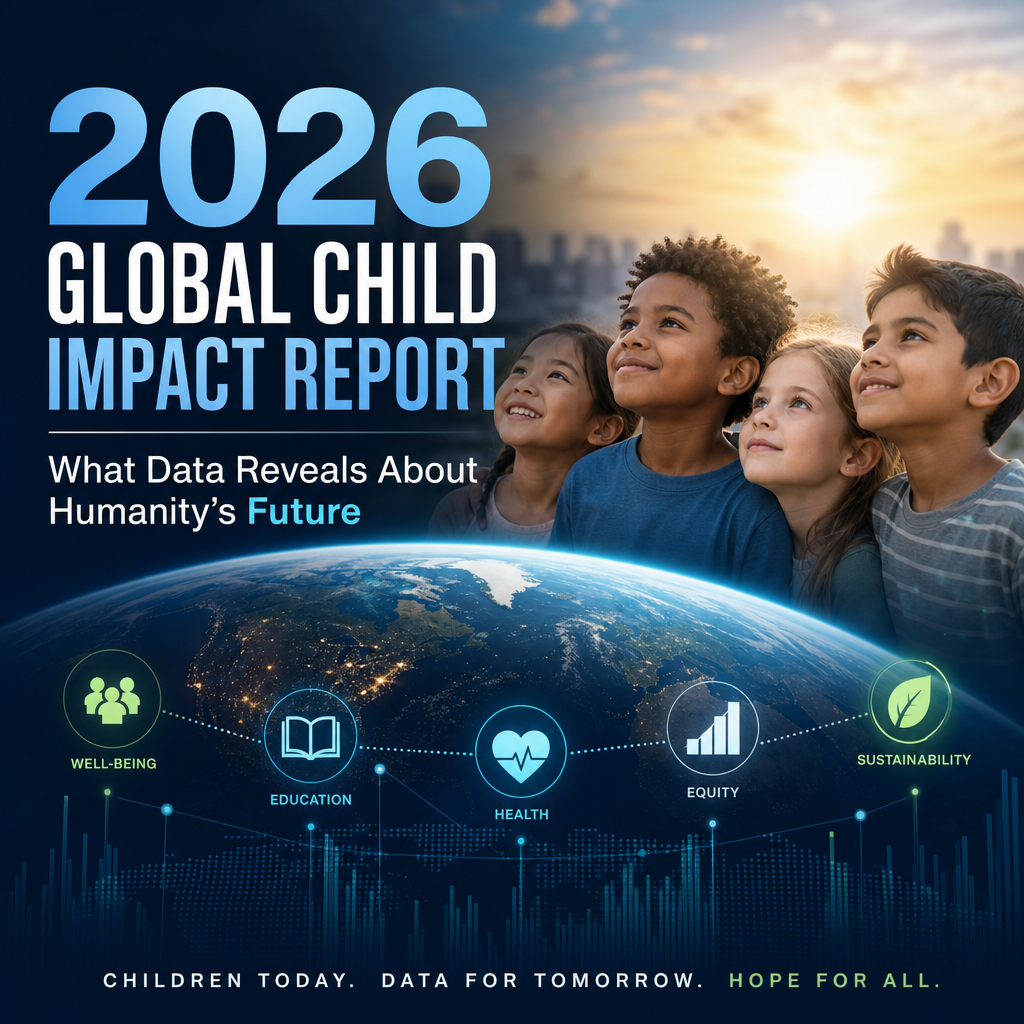
2026 Global Child Impact Report: What Data Reveals About Humanity’s Future
The 2026 Global Child Impact Report: A Window Into Humanity’s Next Chapter
The 2026 Global Child Impact Report is more than a snapshot of childhood around the world. It is a forecast of the future. Children do not just inherit the world we build today; they shape the social, economic, and environmental systems that will define tomorrow. When we look closely at the data, one message stands out clearly: the future of humanity will depend on how well we support children now.
This year’s report brings together evidence from health, education, climate, technology, and family well-being. The results are both encouraging and urgent. Progress is happening, but it is uneven. And the gaps we see today may become the defining inequalities of the next generation.
What the Data Says About Childhood in 2026
The most important insight from the 2026 Global Child Impact Report is that childhood outcomes are becoming more connected than ever. A child’s access to clean water, digital tools, mental health support, and quality learning no longer affects only that child. It shapes long-term community resilience, workforce readiness, and even political stability.
Key trends highlighted in the report include:
-
Health gains are real, but fragile
More children are surviving early childhood than in previous decades, yet access to basic care still varies dramatically by region. -
Education is expanding, but learning quality remains uneven
Enrollment is rising in many places, but too many children still leave school without essential literacy, numeracy, or digital skills. -
Mental health is now a global concern
Anxiety, loneliness, and stress are rising among children and adolescents, especially in communities facing conflict, displacement, or social isolation. -
Climate stress is already changing childhood
Heatwaves, floods, food insecurity, and air pollution are increasingly disrupting children’s health and education. -
Technology is both a bridge and a barrier
Digital access can unlock learning and connection, but unsafe or unequal access can deepen existing divides.
Together, these patterns reveal a simple truth: the future will not be shaped by one issue alone. It will be shaped by how well we solve multiple child-centered challenges at once.
Why Children Are the Best Indicator of Future Stability
When children thrive, societies tend to become stronger, healthier, and more adaptable. When children struggle, the effects ripple outward for decades.
The report shows that countries investing early in child well-being tend to see better outcomes later in areas like:
- economic productivity
- public health
- social trust
- civic participation
- climate resilience
This is because childhood is when the foundations are laid for lifelong learning, emotional regulation, and problem-solving. A child who has safe housing, nutritious food, supportive adults, and quality schooling is far more likely to become an engaged, capable adult. Multiply that by millions, and the connection to humanity’s future becomes unmistakable.
The 2026 Global Child Impact Report suggests that child well-being is no longer just a moral priority. It is a strategic one.
The Biggest Risks Ahead
The report does not paint a bleak picture, but it does warn against complacency. Several risks could slow progress or reverse it entirely.
1. Widening inequality
The gap between children with access to opportunity and those without is growing in many regions. Wealth, geography, gender, disability, and displacement continue to determine too much about a child’s future.
2. Climate disruption
Children today are growing up in a world where environmental instability is no longer a distant threat. It is part of daily life. Schools close because of extreme weather. Food systems are disrupted. Families are forced to move.
3. Digital overload without protection
Children are increasingly connected, but connection alone is not enough. Without strong safeguards, digital spaces can expose them to misinformation, harmful content, and social pressure.
4. Underinvestment in mental health
The report makes it clear that mental health support is still far behind need. If this gap continues, we risk creating a generation carrying preventable emotional strain into adulthood.
What the Report Means for the Future of Humanity
If the 2026 Global Child Impact Report teaches us anything, it is that the future is not predetermined. The data points to possibility, but only if action follows insight.
To build a better future, societies must focus on a few essentials:
- Protecting early childhood development
- Improving access to quality education
- Expanding child mental health services
- Designing climate policies with children in mind
- Ensuring technology is safe, inclusive, and beneficial
- Supporting families with stable income, housing, and care
These are not separate goals. They are parts of the same system. When one improves, others often follow. When one fails, the rest can weaken too.
A Future Worth Building
The most hopeful lesson from the report is that children are not only vulnerable to the future; they are also its greatest source of strength. They bring innovation, resilience, and moral clarity to the challenges adults often struggle to solve.
The 2026 Global Child Impact Report reveals a world at a crossroads. One path leads to deeper inequality, instability, and lost potential. The other leads to shared growth, stronger communities, and a more capable global society.
Which path we choose will depend on how seriously we take the needs of children today. In the end, investing in children is not just about protecting the next generation. It is about protecting the future of humanity itself.