
How Save World Children Mobilizes Rapid Response Teams Globally
How Save World Children Mobilizes Rapid Response Teams During Global Emergencies
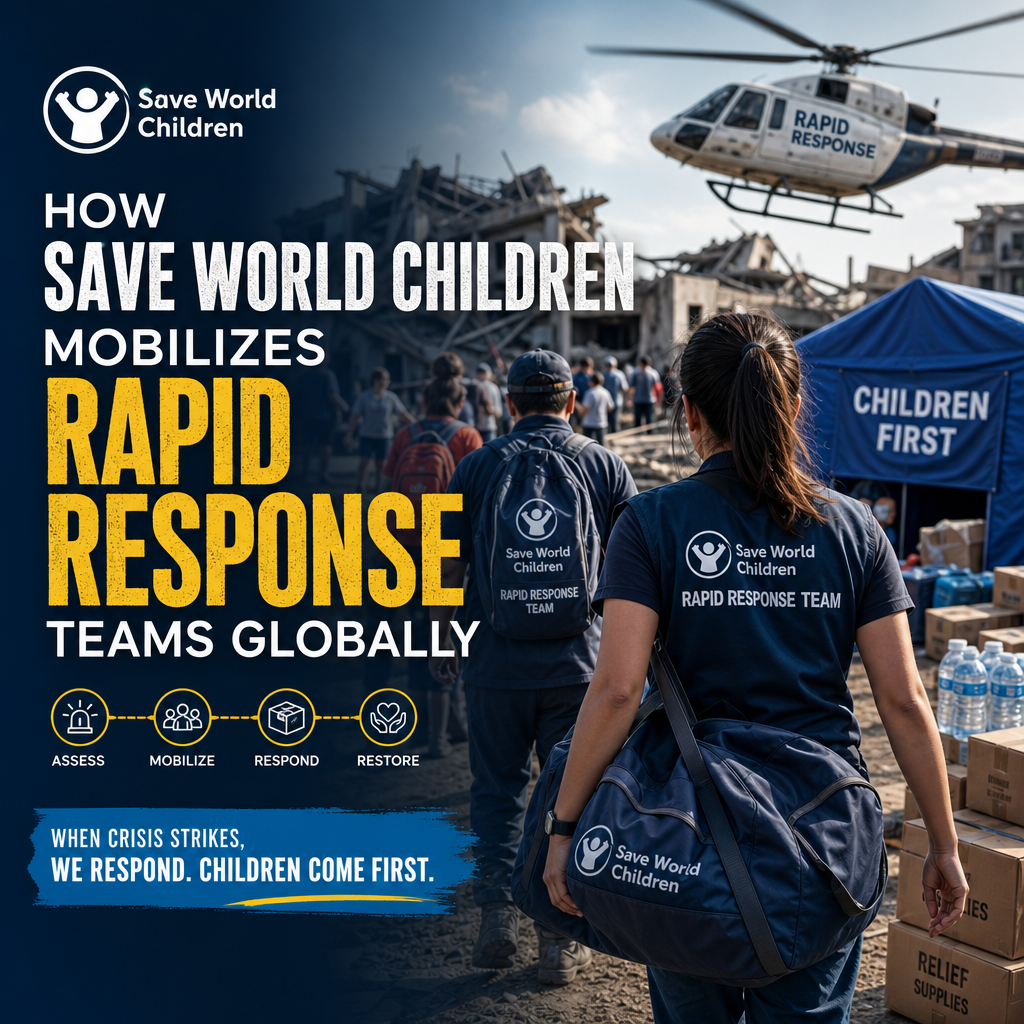
When disaster strikes, every minute matters. Earthquakes, floods, conflict, disease outbreaks, and severe weather can disrupt children’s lives in an instant. In these moments, Save World Children activates rapid response teams designed to reach affected families quickly, assess urgent needs, and deliver lifesaving support.
The strength of this model is speed paired with coordination. Rather than waiting for conditions to stabilize, Save World Children moves early—often while the crisis is still unfolding—to help protect children from the worst consequences of emergency situations.
What Rapid Response Teams Do
Rapid response teams are trained groups of emergency specialists who can deploy on short notice. Their job is to enter crisis-affected areas, gather real-time information, and organize immediate support for children and caregivers.
These teams often focus on urgent priorities such as:
- Safe drinking water and sanitation
- Emergency food and nutrition support
- Medical triage and health referrals
- Child protection and family tracing
- Temporary learning spaces
- Psychological first aid and emotional support
By addressing these core needs quickly, Save World Children helps reduce risk and create stability for families facing uncertainty.
How Deployment Begins
The mobilization process starts with early warning systems and local partnerships. Save World Children monitors global conditions closely, using weather alerts, humanitarian updates, government information, and community reports to identify emerging crises.
Once a threat is confirmed, the organization typically follows a rapid sequence:
-
Situation analysis
Teams assess the scale of the emergency, the most affected regions, and the specific risks facing children. -
Activation of emergency staff
Specialists in health, education, logistics, child protection, and communications are notified and prepared for deployment. -
Coordination with local partners
Save World Children works with community leaders, authorities, and humanitarian agencies to avoid duplication and respond efficiently. -
Deployment and field assessment
Rapid response teams travel to the crisis zone, often carrying essential supplies and assessment tools. -
Immediate intervention
Teams begin distributing aid, setting up safe spaces, and connecting families with emergency services.
This fast, structured response ensures that action is not delayed by confusion or duplication of effort.
Why Speed Matters for Children
Children are often among the most vulnerable in emergencies. They may be separated from caregivers, exposed to unsafe conditions, or deprived of food, healthcare, and schooling. The longer a crisis lasts without support, the greater the danger to their health and development.
Rapid response teams are essential because they can:
- Prevent disease outbreaks by restoring safe water and hygiene
- Reduce malnutrition with quick nutrition interventions
- Support injured or traumatized children early
- Create safe spaces that lower the risk of exploitation and abuse
- Restore routines through temporary education activities
In many emergencies, these early actions can make the difference between short-term disruption and long-term harm.
The Role of Local Knowledge
One of the biggest strengths of Save World Children’s emergency model is local insight. National staff and community partners often know the terrain, the language, the needs of families, and the safest ways to reach remote areas.
This local knowledge improves response in several ways:
- It speeds up access to affected communities
- It builds trust with families
- It helps teams understand cultural and regional needs
- It supports more sustainable recovery efforts
Instead of relying only on outside assistance, Save World Children combines global resources with local leadership. That blend is critical in complex emergencies.
Supplies, Logistics, and Coordination
Rapid response is not only about people—it is also about systems. A team cannot help children if supplies are stuck in transit or if there is no coordination on the ground. Save World Children uses emergency logistics planning to move essential materials quickly and efficiently.
This may include:
- Pre-positioned relief supplies
- Emergency transport arrangements
- Mobile communication systems
- Warehousing and distribution plans
- Partnerships with health and education providers
Strong logistics allow teams to get support where it is needed most, even in hard-to-reach or damaged areas.
Supporting Recovery After the First Wave
While immediate relief is critical, Save World Children’s work does not stop after the first few days. Rapid response teams also help bridge the gap between emergency relief and longer-term recovery. That means tracking changing needs, supporting safe reopening of schools, and helping families regain stability.
Recovery efforts often include:
- Rebuilding child-friendly spaces
- Reuniting separated children with families
- Supporting teachers and schools
- Monitoring nutrition and health outcomes
- Connecting households to ongoing assistance
This broader approach ensures children are not only rescued from immediate danger but also supported as they rebuild their lives.
A Response Built Around Children’s Needs
Global emergencies can be chaotic, but effective response depends on preparation, coordination, and compassion. Save World Children mobilizes rapid response teams by combining early warning, skilled staff, local partnerships, and emergency logistics. The result is a faster, more focused response that protects children when they are most at risk.
In a crisis, children need more than aid. They need protection, stability, and hope. That is exactly what rapid response teams are built to deliver.