
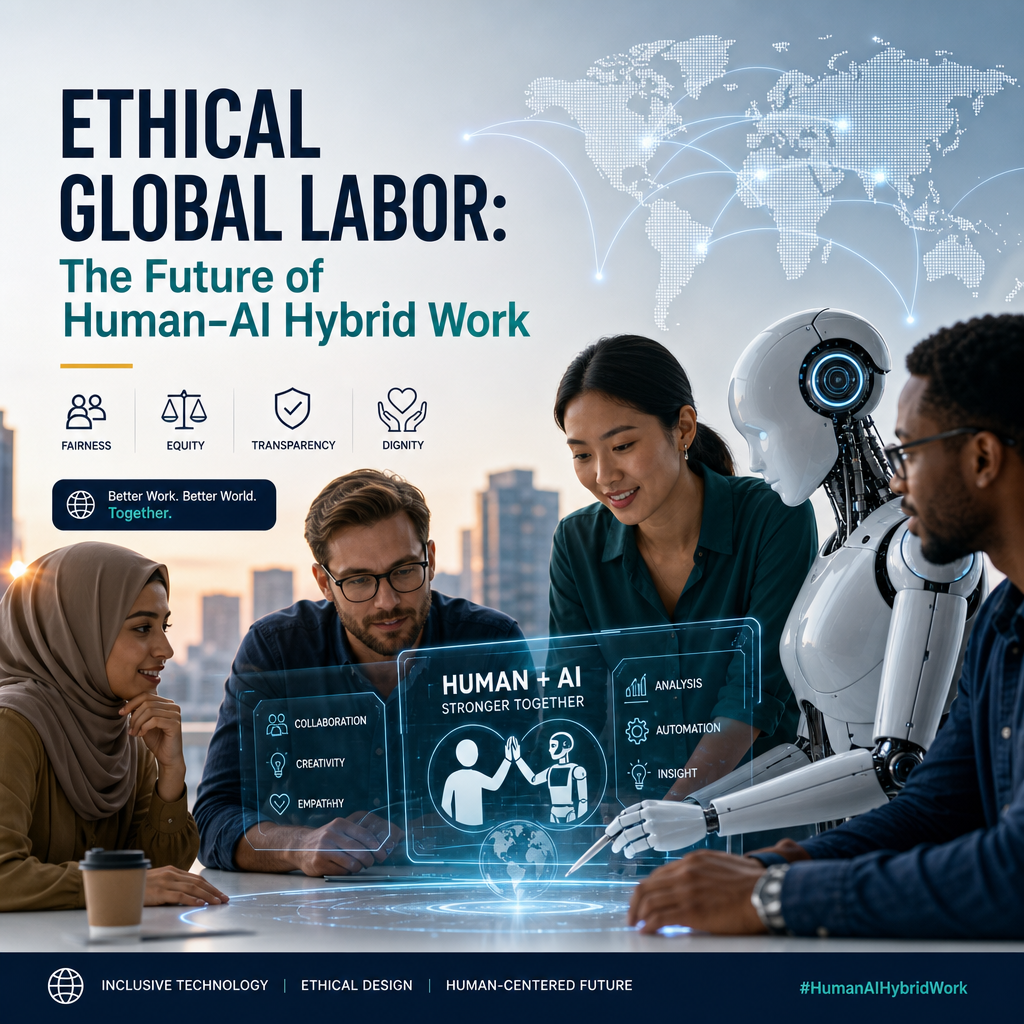
Ethical Global Labor: The Future of Human-AI Hybrid Work
The Future of Ethical Global Labor: Human-AI Hybrid Work Models
Global labor is changing fast. As companies expand across borders and artificial intelligence becomes part of everyday workflows, a new model is emerging: human-AI hybrid work. This approach blends human judgment, creativity, and empathy with AI’s speed, scale, and consistency.
The promise is big. Done well, human-AI hybrid work models could make global labor more efficient, more inclusive, and more ethical. Done poorly, they could deepen inequality, hide exploitation behind automation, and weaken worker protections. The future of ethical global labor depends on which path businesses choose.
What Human-AI Hybrid Work Really Means
Human-AI hybrid work is not about replacing people with machines. It is about assigning tasks to the right strengths.
AI handles repetitive, data-heavy tasks
AI can:
- Sort large amounts of information
- Translate content across languages
- Flag anomalies in reports
- Support scheduling and workflow management
- Provide first-draft content or code
Humans handle judgment and nuance
People are still essential for:
- Cultural interpretation
- Ethical decision-making
- Relationship-building
- Creative problem-solving
- Managing sensitive situations
This division of labor can improve productivity while preserving human oversight. More importantly, it can help businesses operate globally without sacrificing fairness or accountability.
Why Ethical Global Labor Matters More Than Ever
As companies scale internationally, labor practices often become harder to monitor. Contractors may be spread across multiple countries. Supply chains can be opaque. Digital platforms can assign work at speed, but not always with transparency.
That is where ethical global labor becomes crucial. It means designing work systems that respect:
- Fair pay
- Safe working conditions
- Worker autonomy
- Data privacy
- Equal access to opportunity
- Transparency in decision-making
AI can support these goals, but only if organizations intentionally build them into their systems.
The Benefits of Human-AI Hybrid Work Models
The strongest argument for hybrid work is that it can create a better balance between efficiency and responsibility.
1. More inclusive access to global work
AI-powered translation, onboarding, and communication tools can help people participate in international projects regardless of language or geography. That can open doors for workers in regions that have historically been excluded from higher-value digital work.
2. Better task allocation
Hybrid systems can match work more intelligently. Routine work can be automated, while more complex tasks go to people with relevant expertise. This can reduce wasted time and help workers focus on meaningful contributions.
3. Improved consistency and oversight
AI can identify patterns in payroll, compliance, and performance data that humans might miss. Used properly, it can help organizations spot unfair treatment, missed payments, or workflow bottlenecks earlier.
4. More room for human value
When AI handles repetitive chores, workers can spend more time on strategy, creativity, and collaboration. That shift can make global labor more satisfying and less extractive.
The Risks That Cannot Be Ignored
Despite the promise, human-AI hybrid work models also create serious risks.
Algorithmic bias
If AI systems are trained on biased data, they can reinforce inequality in hiring, promotion, pay, or performance evaluation. Workers in certain regions, languages, or demographic groups may be disadvantaged without realizing it.
Surveillance and control
AI can be used to monitor productivity in intrusive ways. Excessive tracking can erode trust and turn flexible digital work into a high-pressure environment with little autonomy.
Job displacement
Some tasks will disappear as automation expands. Without thoughtful planning, low-wage and routine workers may be the first to lose opportunities.
Unequal access to AI tools
Workers and companies with better technology will have an advantage. If access is uneven, hybrid models could widen the gap between high-income and low-income labor markets.
What Ethical Design Should Look Like
To make hybrid work models truly ethical, companies need more than efficiency goals. They need a labor-first approach.
Key principles for ethical implementation
- Human oversight: Important decisions should not be fully automated.
- Transparency: Workers should know when AI is being used and how it affects them.
- Fair compensation: Productivity gains should not come only from reducing labor costs.
- Privacy protections: Worker data must be collected and used responsibly.
- Ongoing training: Employees need support to adapt to new tools and roles.
- Accountability: Organizations should audit AI systems for bias and harm.
Ethical global labor is not just about avoiding abuse. It is about building systems where workers can thrive alongside technology.
The Human Skills That Will Matter Most
As AI takes on more routine tasks, the value of human skills will rise. The most important abilities in the future of work may be the ones machines struggle to imitate.
These include:
- Empathy
- Negotiation
- Leadership
- Cross-cultural communication
- Ethical reasoning
- Adaptability
In global teams, these skills are especially important. Hybrid work models will succeed when humans provide the context, care, and judgment that AI cannot.
A Better Future Is Possible
The future of ethical global labor will not be determined by technology alone. It will be shaped by policy, company values, and worker advocacy.
Human-AI hybrid work models offer a rare opportunity: they can make global labor more productive without making it more dehumanized. But that outcome is not automatic. It requires deliberate choices about who benefits, who is protected, and who gets a voice in the system.
If organizations treat AI as a tool for augmenting human dignity rather than replacing it, the next era of global labor could be more fair, more inclusive, and more sustainable than the one before it.