
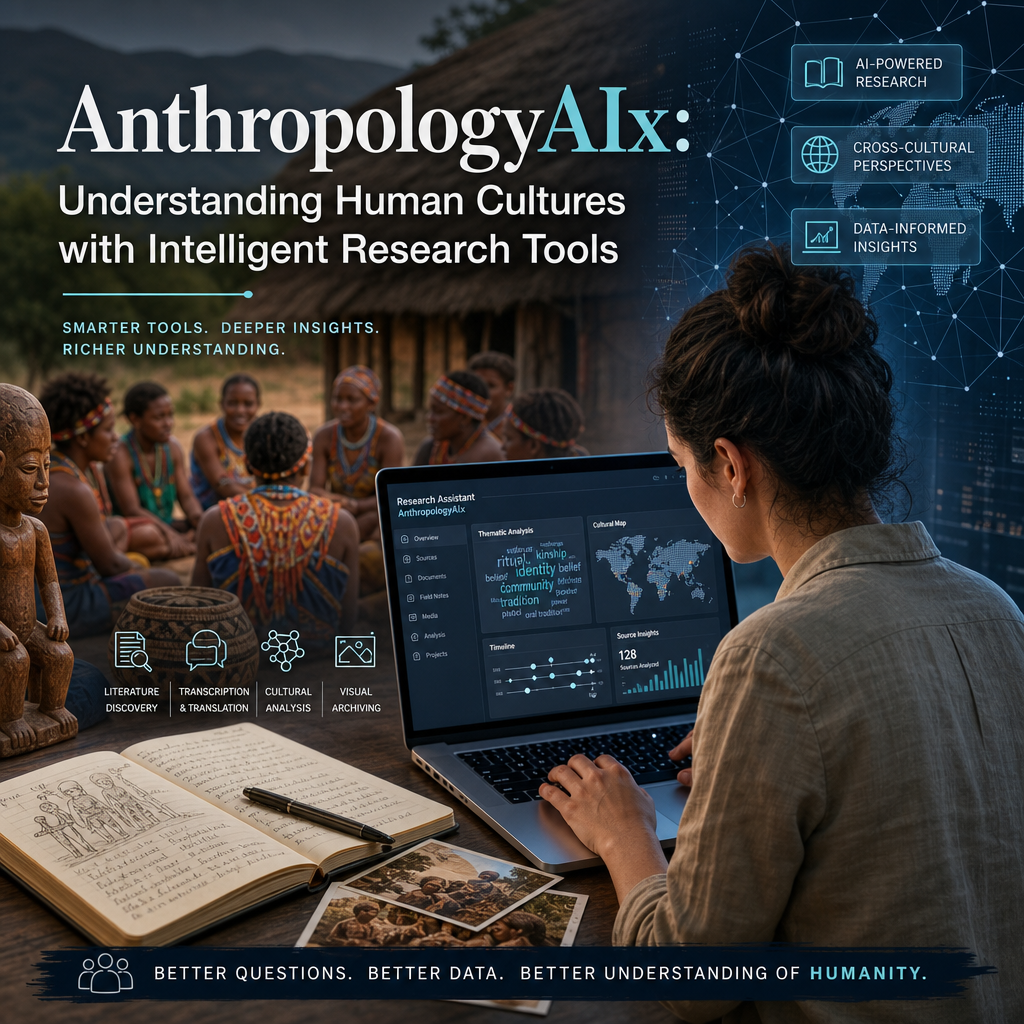
AnthropologyAIx: Understanding Human Cultures with Intelligent Research Tools
AnthropologyAIx: Understanding Human Cultures Through Intelligent Research Tools
Anthropology has always been about people: how they live, what they believe, how they organize societies, and how culture changes over time. Today, that work is being transformed by AnthropologyAIx, a new approach that combines anthropological inquiry with intelligent research tools.
Rather than replacing human researchers, AnthropologyAIx strengthens their ability to observe patterns, compare sources, and explore culture at scale. It helps anthropologists work faster and more deeply while still preserving the critical thinking and ethical sensitivity the field requires.
What Is AnthropologyAIx?
AnthropologyAIx refers to the use of AI-powered tools in anthropological research. These tools can help researchers process large amounts of data, identify themes in field notes, analyze language patterns, and organize visual or audio materials.
This approach is especially useful in a field where evidence often comes from many different sources, such as:
- Interviews
- Community archives
- Ethnographic field notes
- Oral histories
- Social media content
- Photographs and video recordings
By combining human interpretation with machine assistance, AnthropologyAIx makes it easier to study culture in more complete and connected ways.
Why Intelligent Research Tools Matter
Traditional anthropology relies on careful observation, long-term fieldwork, and close reading of cultural context. These methods remain essential. But modern researchers often face an overwhelming volume of information.
Intelligent tools can help by:
- Sorting and tagging large collections of qualitative data
- Translating materials across languages
- Detecting recurring concepts and cultural themes
- Mapping relationships between people, places, and events
- Summarizing large documents for faster review
These capabilities do not remove the need for anthropological expertise. Instead, they free researchers to focus more on interpretation, comparison, and theory-building.
How AnthropologyAIx Supports Cultural Research
One of the greatest strengths of AnthropologyAIx is its flexibility. It can support different stages of research, from collecting data to publishing findings.
1. Organizing field data
Anthropologists often gather notes, recordings, transcripts, and images in the field. Intelligent tools can help label and categorize these materials so researchers can find patterns more easily later.
2. Analyzing language and stories
Culture is often embedded in language. AI-assisted text analysis can identify repeated words, emotional tones, or changing narratives across interviews and documents. This can reveal how communities talk about identity, memory, migration, or belonging.
3. Comparing large datasets
When researchers study multiple communities or time periods, manual comparison can be slow. AnthropologyAIx makes it easier to compare themes across datasets while keeping the cultural context intact.
4. Supporting translation and accessibility
Many anthropological projects involve multilingual communities. AI translation tools can make information more accessible, though researchers still need to verify meaning carefully because cultural nuance can be lost in automated translation.
The Human Side Still Matters
Even with powerful tools, anthropology remains a deeply human discipline. Machines can identify patterns, but they cannot fully understand lived experience, social meaning, or cultural complexity.
That is why AnthropologyAIx works best when researchers keep a few principles in mind:
- Context comes first. Data must always be interpreted within cultural and historical settings.
- Bias must be checked. AI tools can reflect hidden assumptions in their training data.
- Community voices matter. People being studied should have agency in how their stories are collected and represented.
- Ethics are essential. Privacy, consent, and respectful use of data must guide every project.
In anthropology, it is not enough to know what is being said. Researchers also need to understand who is saying it, why it matters, and how it fits into broader social life.
New Possibilities for Fieldwork and Research
AnthropologyAIx is opening new possibilities for the field. Researchers can now combine ethnographic depth with digital scale, creating a more dynamic picture of culture.
For example, AI tools can help anthropologists explore:
- How online communities form identity
- How traditions change across generations
- How migration reshapes family networks
- How symbols and rituals spread across regions
- How cultural narratives shift during social change
These insights are especially valuable in a world where culture is increasingly digital, global, and interconnected.
Challenges and Cautions
Like any research method, AnthropologyAIx has limitations. AI systems can misread slang, miss sarcasm, or flatten cultural differences. They may also reproduce inequities if the underlying data is incomplete or skewed.
Researchers should be cautious about over-relying on automated summaries or pattern detection. The most meaningful anthropological insights still come from careful reading, listening, and engagement with communities.
Responsible use of intelligent tools means treating them as assistants, not authorities.
A Smarter Future for Anthropological Research
AnthropologyAIx represents an important shift in how scholars study human life. It brings together the depth of anthropology and the speed of intelligent research tools, creating a more efficient and expansive way to explore cultures.
Used thoughtfully, it can help researchers uncover connections that might otherwise remain hidden. More importantly, it can support a form of anthropology that is both technologically advanced and deeply respectful of the people and communities at its center.
As culture continues to evolve, AnthropologyAIx offers a powerful way to keep up with its complexity while staying true to the field’s core mission: understanding what it means to be human.